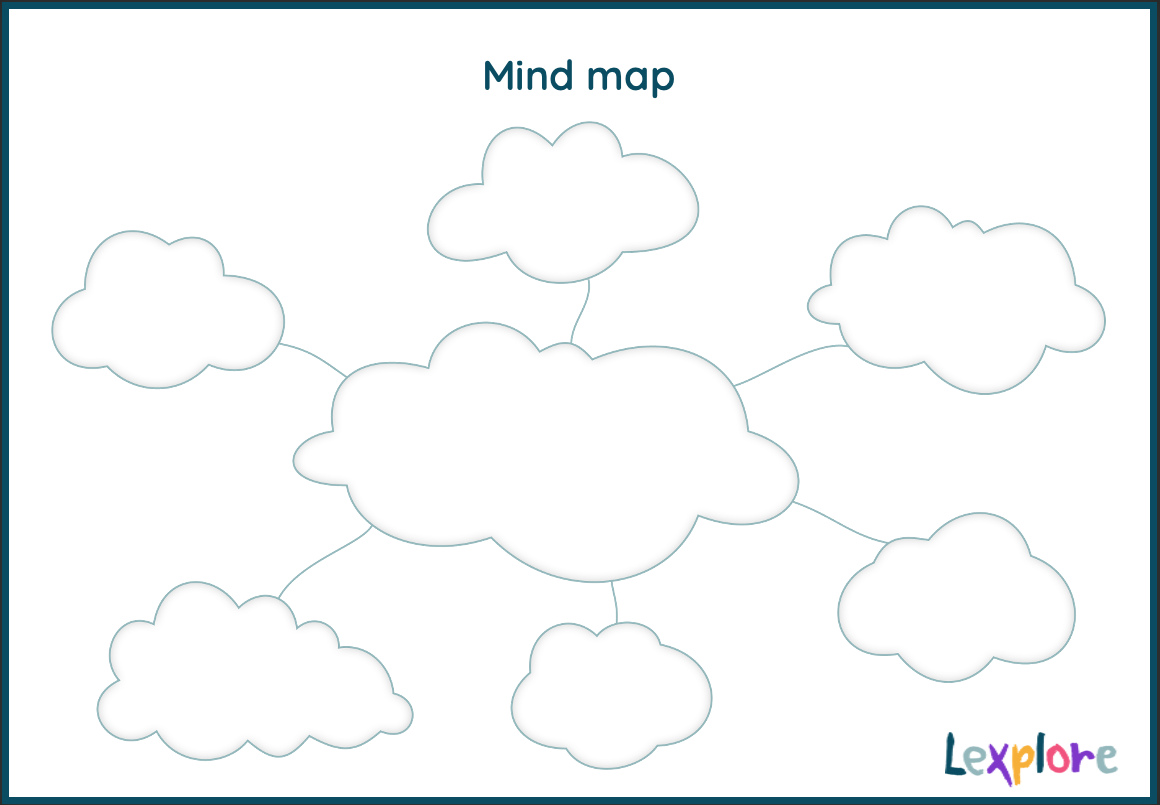
Summarising using a mind map
Pupils learn to summarise the most important information in a non-fiction text.
In order to summarise the text, pupils must keep track of the most important pieces of information while reading.
- Let pupils use a mind map to record this information as they read.
- They can work in groups, pairs, or individually.
- The sample mind map provided is intended to be used with a chapter consisting of a title and section headings.
- When pupils have read and filled in the mind map, they can use it to help them summarise the text.
Begin by modelling.
- Choose a shorter chapter or section from a textbook.
- Read it aloud for the pupils and as you read, pause when you come to information which is critical to understanding the content.
- Record the most important points on the mind map.
- Finally, demonstrate how you can use the mind map to write a short summary of the text you read.
Sometimes, pupils will need help with conjunctions, or linking words, when they write summaries.
Here are examples of conjunctions that have to do with comparison, contrast, time, sequence, addition, clarification, example, cause and effect, and conclusion.
Compare or contrast
However, but, although, anyway, despite, after all, on one hand, on the other hand, on the contrary, contrary, a difference is, in return, in turn, instead, the upside, the downside, in this way, in the same way.
Time and sequencing
Initially, immediately, thereafter, during, while, meanwhile, at the same time, before, after, eventually, soon, after a while, later, first, previously, finally, at last.
Addition
Even, and, also, in addition, as well, further, additionally, furthermore, next, first and foremost, finally, last but not least, moreover, not only...but also...
Clarification and examples
Such as, for example, among other things, in other words, as an example of, illustrated by, more precisely, as shown here, especially, for instance, namely, notably.
Cause and effect
Therefore, depending on, based on, because of, the reason being, in light of, considering, the reason being.
Consequence and conclusion
As a result, consequently, thus, therefore, which leads to, because of, the result is, the effect of which is.