Summarising using keywords
Feel free to work on the lesson Summarising with a mind map before students summarise with keywords. This will also support you in presenting connection words.
Students will learn to summarise the main points of a non-fiction text by identifying and using keywords.
In order to summarise a text, students need to collect keywords during their reading. The keywords help them focus on the most central content and create a clear and coherent summary.
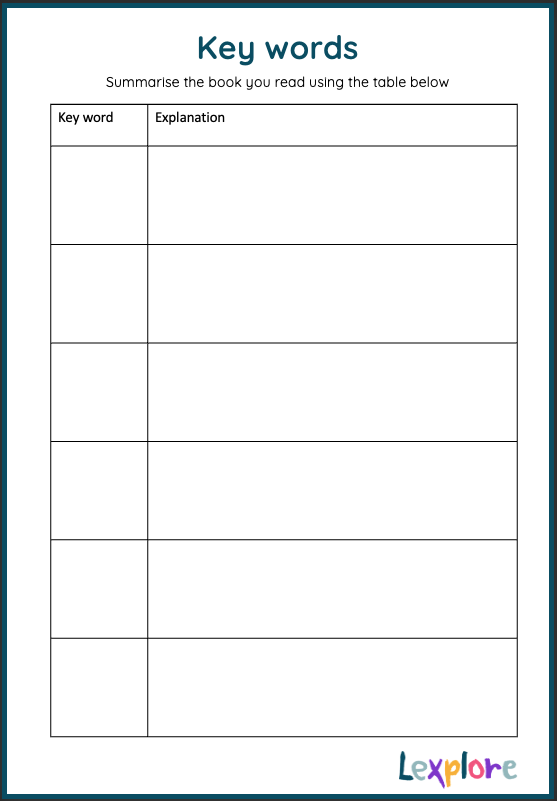
Have students use a simple template where they can fill in keywords and their explanations for the words.
They can work in groups, pairs or individually, depending on their needs and level.
Preparing to work with keywords
For students to gain a prior understanding of the text, they can
- Look at headlines, pictures and fact boxes.
- Identify subject-specific concepts.
- Read the text for the first time on your own or together.
Let students work with the text in different ways before summarising, for example, by
- Summarise the main message of the text in one sentence.
- Formulate a question about something they do not understand or find interesting.
- Highlight sentences or paragraphs where important keywords appear.
Carrying out the work on keywords
Start by modelling
Choose a short non-fiction text from the textbook.
Read the text aloud to the students
Stop at words that are central to understanding.
Discuss what makes these words important.
Fill in a keyword template together
- Write down keywords from the text.
- Add simple explanations or synonyms to each word.
Show how the words can be used in a summary
- Use the selected keywords to write a summary of the text.
- Demonstrate how linking words can help to create fluency in the summary.
Students' work with keywords
Reading and identifying keywords
- Students read a non-fiction text and highlight important words.
- They fill in a keyword template where they write down the words and their meaning.
Using the keywords to summarise
- Using the keywords, students formulate a written or oral summary.
- They practise using the words in their sentences to ensure understanding.
Discussion and comparison
- Have students compare their keywords and summaries in pairs or small groups.
- Discuss whether the selected words are the most central or whether something is missing.
Example of a keyword template:
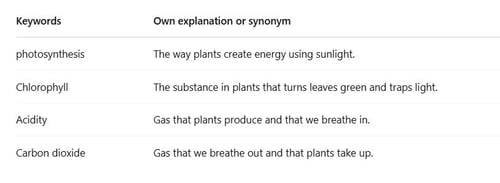
Students can then use these keywords to write a summary, for example:
"Photosynthesis is the process by which plants use chlorophyll and sunlight to create energy. During this process, oxygen is produced, which is important for humans and animals. For this to happen, plants take up carbon dioxide from the air."
Exercises to deepen the work with keywords
The word chain
Students are given a keyword and have to explain it in their own words.
The next student should use the explanation and link it to another word from the text.
False keywords
The teacher adds some irrelevant words to a list of keywords.
Students discuss which words are important for the content of the text.
Oral summary with keywords
Pupils are given a list of keywords and have to orally summarise the text without reading directly from the text.
This exercise helps them to express themselves freely and develop their language.
Have students first work on the keywords in small groups before writing their summary individually.
This method provides students with a structured way of identifying the main points of a text and develops their ability to summarise in a clear and coherent way.