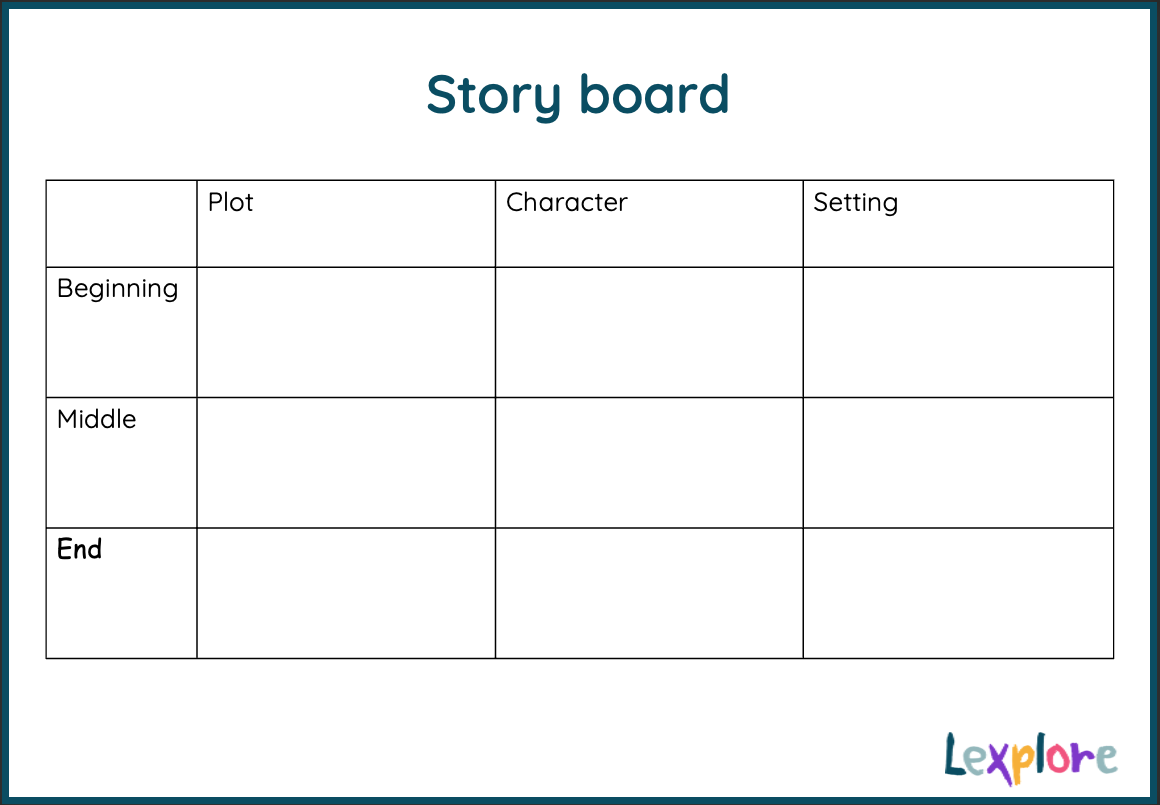
Summarising using a story board
Students will learn to summarise the main points of a read book or chapter using a story map. Using a story map provides students with a structured way to capture the key elements of the text, helping them to better understand and process the story.
Preparation
Choose a chapter from a fiction book that is suitable for the age group and has enough content to be summarised using a storyboard.
Students should have access to paper and a pencil to fill in their story diagrams.
The exercise can be carried out in one or more lessons, depending on the scope and needs of the book.
Procedure
The exercise starts with the whole class.
Start by reading a chapter of the book aloud
Read a chapter to the students and model how the chapter can be summarised using a story map. Go through the different categories in the story map, for example:
- Main character
- Problem or challenge
- Events
- Solution
- The end
Think aloud and show students how to fill in each category based on what you have read. Make connections between the text and each category so that students understand how they can use these elements to summarise a story.
Read another chapter aloud
Once you have summarised the first chapter, read another chapter aloud. Now have students fill in a story chart in pairs. Give them time to discuss and fill in the different categories, and go round the classroom to help if necessary.
Read another chapter aloud
After reading another chapter, have students fill in their story chart for this chapter. Give them time to think about what is most important in the story and how they can summarise it using the different categories.
Gather students and discuss their story diagrams
Gather the students and have some students read out their story diagrams. Discuss similarities and differences in their summaries:
How come they are the same?
Why is it different?
This helps students to reflect on why they have chosen to focus on different parts of the text and shows how stories can be interpreted and summarised in different ways.
Continue reading the book and summarise with a story map
Once you have read the rest of the book, have students create a story map of the entire content. This will give students an overall picture of the story and help them reflect on the structure and development of the whole book.
Support issues
Who is the main character, and what is their biggest challenge?
What events lead to the problem or challenge arising?
What does the main character do to solve the problem?
How does the story end, and what does the ending mean for the main character?
What did you learn from summarising the story in this way?
In-depth
Once pupils have practised summarising with the story schema, they can move on to probing questions that help them think more deeply about the structure of the text and the development of the characters.
Questions based on the main character and their development
How has the main character changed from the beginning to the end?
What factors have influenced the protagonist's development?
How would you describe the main character's biggest lesson?
If the protagonist had not done a certain action, how would the story have changed?
Questions linking the action to the theme
Which parts of the plot do you think are most central to the theme of the book?
How does the development of the plot affect the messages the author is trying to convey?
Is there an event that changes the direction of the whole story? Why is this event important?
Questions that reflect on the resolution of the story
How do you think the story ends?
What do you think about the solution to the main character's problem?
If you could change the ending, what would you change and why?