Step 3: Becoming an independent reader of a non-fiction text
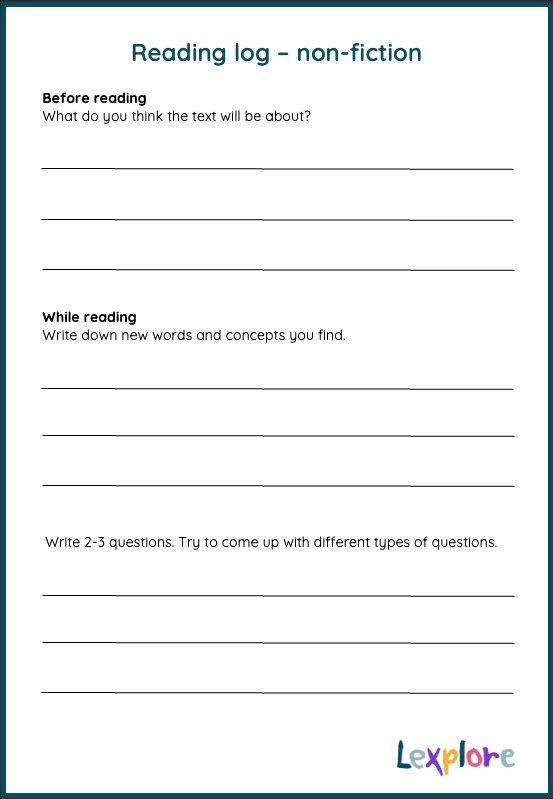
This exercise aims to make students aware of what they need to focus on when reading factual texts, such as keywords, central facts and the ability to ask questions to process and understand information. The reading log acts as a guide to help them keep track of their thoughts and reflections and allows them to process and summarise the text in a structured way.
Remember to adapt to your students, as this can be difficult at first, and students need a lot of support. You can usefully carry out the same exercise for different factual texts so that students can consolidate their way of working well.
Once students have a basic understanding of factual texts, they can begin to read independently and take greater responsibility for their learning. Divide students into pairs to support each other during the reading.
Before reading
Activate prerequisites:
Let the students look at the front of the book together and discuss:
What do you see in the picture? What conclusions can we draw about the content of the text?
What do you think the text will be about?
What do you already know about the topic? What would you like to know more about?
Predictions:
Let students make their own predictions about what the text will be about based on headings, captions, or any prior information.
Discuss together what type of factual text it is (descriptive, explanatory, argumentative) and what the author's purpose might be with the text.
Questions:
Ask students to write down questions they hope to find answers to during the reading.
It could be about:
What is the topic about?
What facts or details will be important?
What do I need to understand to be able to summarise the text?
During reading
Pair read the text:
Let students take turns reading the text in pairs. Let them know which pages they should stop at before filling in the reading log.
You can write down which sections students should pause at so that reading pairs can work at their own pace.
Reflect and analyze:
During each reading stop, students should think about and discuss:
What have I learned so far?
Is anything unclear? What would I like to know more about?
What facts and keywords have I uncovered?
After reading
Summary of the text:
Encourage students to discuss and summarise the content of the text using the keywords they have collected.
Have students use the reading log and keywords to write a summary, either in writing or orally.
Reflection on learning
Let students reflect on what they have learned from the text.
Some examples of questions to discuss:
What do you think the author wanted us to learn?
What was most important in the text?
Have I learned anything new about the topic?
Comparison with predictions:
Discuss whether students' predictions before reading were consistent with what they read. What surprised them? What was confirmed?
Meta conversation:
Allow students to discuss what went well during the reading and what was difficult.
Question:
Which strategies were most helpful?
Was there any part of the text that was particularly challenging?
What can we think about the next time we read a factual text?