How to achieve a balanced approach to teaching reading
Reading Power
Reading is a powerful skill that can open up a world of knowledge, imagination and self-improvement. Lexplore wants to give you the tools to teach reading effectively so your students develop optimally.
It is about developing and using these skills effectively to maximise the value of our reading experience.
Apart from decoding, which is the technical part of reading, there are several other parameters that you can develop in your students.
Reading Power is an umbrella term for these skills created by Adrienne Green (2019).
Vocabulary and concepts
Vocabulary is an important part of reading comprehension. Building a large vocabulary allows us to understand and interpret texts more accurately and nuancedly. Connecting new words to prior knowledge and context is crucial to developing a strong vocabulary.
Reading strategies
Reading strategies help us understand texts by identifying keywords, creating mental images and asking questions. We can increase our understanding of the main ideas, details and context by actively engaging with the text.
Thinking skills
Critical thinking is an important part of reading. It means being sceptical, analytical and reflective as we read. By questioning and evaluating information, we can distinguish between facts and opinions, spot errors and draw conclusions.
Enjoyment of reading
Having a positive attitude towards reading and feeling motivated is essential to continue developing reading skills. By finding books and topics that interest us, we can deepen our reading experience and discover new worlds and perspectives.
Summary
In summary, Reading Power focuses on developing different reading skills to maximise students' reading experience and reading ability.
Balanced reading instruction
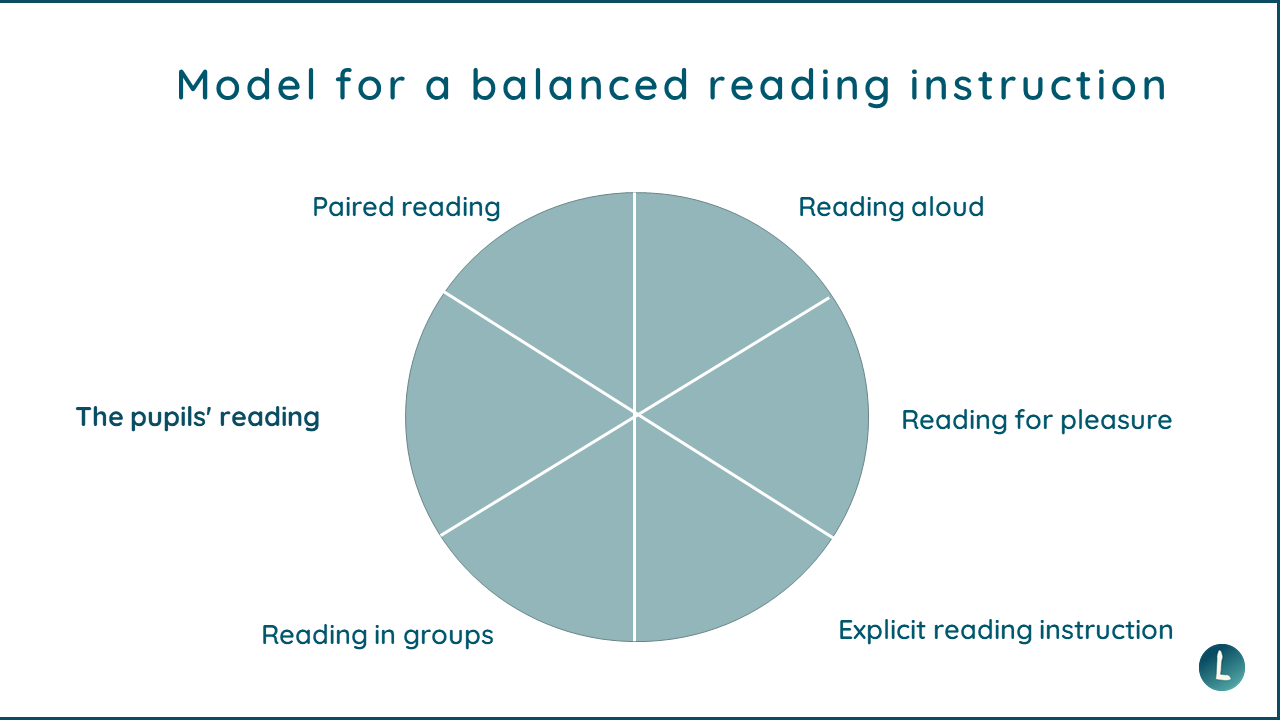
We recommend using the Balanced Reading model to ensure that your teaching includes the components described above.
With the help of this model, you and your colleagues can analyse your reading instruction so that there is a good distribution between different elements that promote reading development to increase reading ability.
Explicit reading instruction should play a central and important role in teaching, as it is where you, as a teacher, can systematically go through all the elements that develop reading.
The different components
Reading for pleasure
Independent reading with no subsequent activity such as questions or tasks.
The pupils' reading
Silent reading with subsequent questions or tasks.
Paired reading
Two or more pupils read to increase reading fluency.
Reading aloud
Teacher reads aloud for the class.
Explicit reading instruction
Teacher-led teaching of words/concepts, grammar (language comprehension) and reading strategies (approximately two weekly lessons should be devoted to teacher-led reading instruction and cooperative learning).
Reading in groups
Pupils read the same text, followed by discussion or tasks.
The Lexplore lessons and exercises will help you.
Summary
- Teaching and using Lexplore materials allows you to create a balanced reading program.
- Balanced reading instruction means that you have a balance between pupils' reading and the explicit teaching of reading strategies and language comprehension.
- Balanced reading instructions involve integrating these various components in a balanced manner to support pupils' overall development as readers.
You can download the guide to help you and your colleagues develop your teaching of reading!
Good luck!