To summarise
Students will learn to summarise the main points of a read book or chapter.
By summarising a text, pupils develop their ability to identify the main points of a story and express them in their own words.
Model how to summarise
Start by reading a chapter of a book aloud and show how you summarise the chapter or book.
Involve students by
think with you about what is most important in the chapter, discuss how to formulate a summer,y use support structures to organise the content
After you have modelled, students can summarise the chapters that follow in small groups or on their own.
Using a graphical support
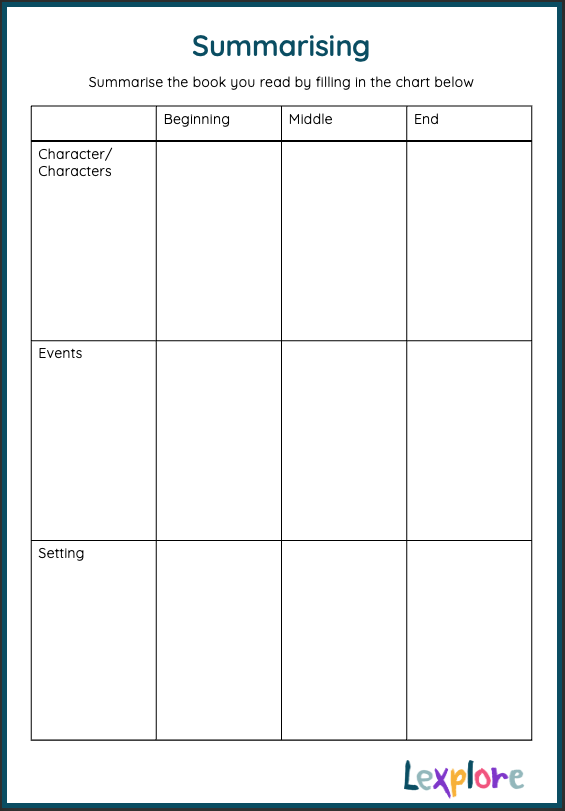
To help students structure their summary, they can use a template that includes
- Who is the book or chapter about (characters)
- What is the most important thing that happens (events in the beginning, middle and end)
- Time and environment
Once students have filled in the template, they can use it to support them in writing their summary.
Next steps - deepening and reflection
Comparing summaries
Have students read their summaries to each other in pairs or small groups. They can discuss
Have we covered the same events?
Have any of us missed something important?
How have we phrased ourselves to make the summary clear?
By comparing summaries, students learn to see what is most central to the text.
Writing summaries in different formats
Have students try summarising a book or chapter in different ways
- A written summary using the template.
- An oral summary where they tell a friend about the book.
- A summary in bullet point form, which lists the main events.
- A series of pictures where they draw important scenes from the book and write a short text for each picture.
Working with summarisation in different ways allows students to develop their understanding and ability to express themselves.
Discuss the importance of summarising
Have students reflect on why it is good to be able to summarise
When can you benefit from summarising a text?
How can a summary help someone who has not read the book?
How can you use summaries in other subjects?
Closing and reflection
Conclude the lesson with a discussion where students can share their experiences of summarising
What was easy and difficult about summarising?
How did the template help them?
How can they use this strategy in future reading?
By practising summarising texts, students learn to identify the most important points and express them clearly, which strengthens both their reading comprehension and writing skills.