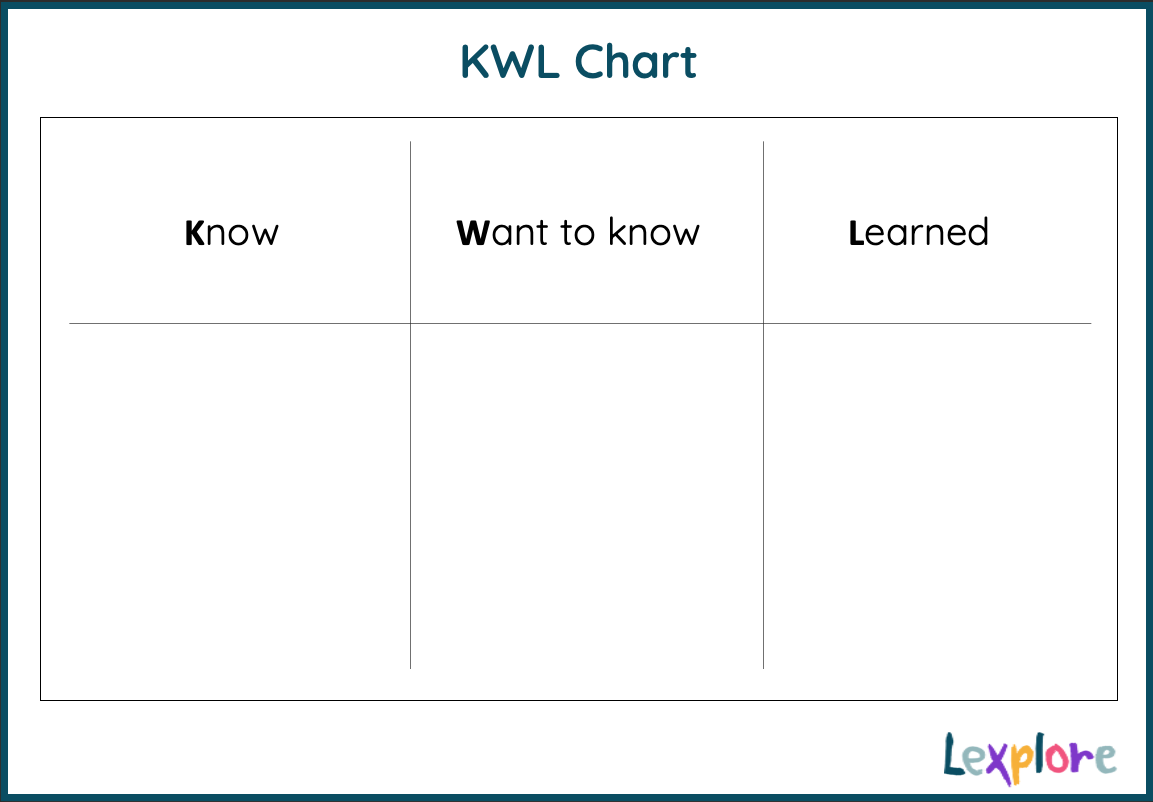
KWL chart
This exercise is intended to help the students actively use their prior knowledge and arouse their curiosity about a new subject area. By using the KWL chart, Students are given the opportunity to reflect on what they already know, what they want to learn, and what they have learned after reading a factual text.
Preparations
Draw the KWL chart on the board or display it digitally.
Have access to a factual text or a work area that you will work on during the Lesson.
Make sure the students have a simple template for the KWL chart to fill out.
Implementation
Before reading: Activate prior knowledge
Start by introducing the topic to be covered. For example, it could be a non-fiction text about an animal, a historical event or a natural phenomenon.
Draw the KWL chart on the board:
K = Know: Write down what the students already know about the topic. Ask them to think about previous experiences or knowledge they have about the topic. Encourage the students to share their thoughts with the whole class
W = Want to know: Ask them to think about what they would like to know more about the topic. What are they curious about? Give them some time to reflect and discuss in pairs or small groups.
While reading - Process the text
Read the text together in class, preferably dividing it into smaller parts so as not to overwhelm the students.
Stop at appropriate reading stops and use reading strategies such as predicting, asking questions, or picking out keywords.
Use the questions discussed earlier to guide the students through the text. Encourage them to ask questions about the text at different levels: on the lines, between the lines, and beyond the lines.
Let the students discuss words, concepts, and any difficulties together in pairs or small groups.
Fill in the KWL chart while reading to summarize what has been learned and what is still unclear.
After reading - Reflection and summary
Gather the students and discuss what they have learned during the reading.
Fill in the column L = Learned on the KWL chart together.
Reflect together on whether the students have received answers to their questions about what they wanted to know. If there are any unanswered questions, discuss how to find answers or search further.
Let the students write down their reflections about what they have learned in their KWL charts and compare them with what they had as wishes before reading.
Follow-up
Give them the opportunity to complete their own KWL charts individually or in pairs for future factual texts. Encourage them to use this method to work with other subject areas.
Return to the KWL chart to reflect on their learning and development throughout the reading process.
Suggestions!
For younger students or those new to reading, you can use pictures or simple texts that relate to their everyday lives. Ask your students to draw what they know about the topic and to create simple questions around their thoughts.
for those who have difficulty formulating their thoughts, you can provide examples of questions to help them get started, such as: "What do you think this text will be about?", "Have you seen anything similar in real life?"