Introduction to reading strategies
Content and structure
Lexplore provides lessons, exercises and schemes for working with reading strategies, both for fiction and non-fiction.
All lessons and exercises should be seen as suggestions on how to work consciously to help pupils understand a text on, between and beyond the lines.
The lessons and exercises are general so that they can be applied to different types of texts that you choose and can be adapted to your teaching and group.
You will find tasks that you and your pupils can work on before, during and after reading.
Many of the models and activities are accompanied by instructions and questions directly addressed to the pupils.
The lessons and exercises will give you suggestions for a way of working where the work with different texts is placed in a meaningful context, where pupils can work explicitly to improve their understanding.
Please note that non-fiction reading is suitable for use in all school subjects and Lexplore recommends that all teachers be involved in the explicit teaching of non-fiction reading strategies.
Working method
When conducting activities, in general, you should model, think aloud and show your pupils how different exercises work, before letting them work on their own or with others.
It is recommended that you follow the same structure in all lessons so that pupils can also recognise this easily and become familiar with the structure.
- As a teacher, you always need to model and demonstrate. One suggestion is that you are the teacher and the pupils can be "one pupil" and help each other.
- Pupils work on the task in pairs or small groups. You have the opportunity to listen to them and give feedback. You can also choose to go back to step 1 if you feel that many pupils have not understood.
- Pupils practise skills on their own. Here you have the opportunity to provide more support and let some pupils continue to work in pairs if you don't feel that they have understood.
Recommended reading comprehension strategies
The basic strategies included do not have to be done in a particular order, but can be adapted to the text to be worked on. You do not have to use all the strategies every time, but the model is most effective if you use more than one of the strategies.
The aim is for pupils to become familiar with all the strategies and then to be able to choose a strategy depending on the purpose of the reading when working independently and as they progress.
For the youngest pupils, we introduce the strategies using five characters. We start with characters created by Lori Oczuks (2018) called "The fab four characters". The aim is that they help pupils to remember the different strategies.
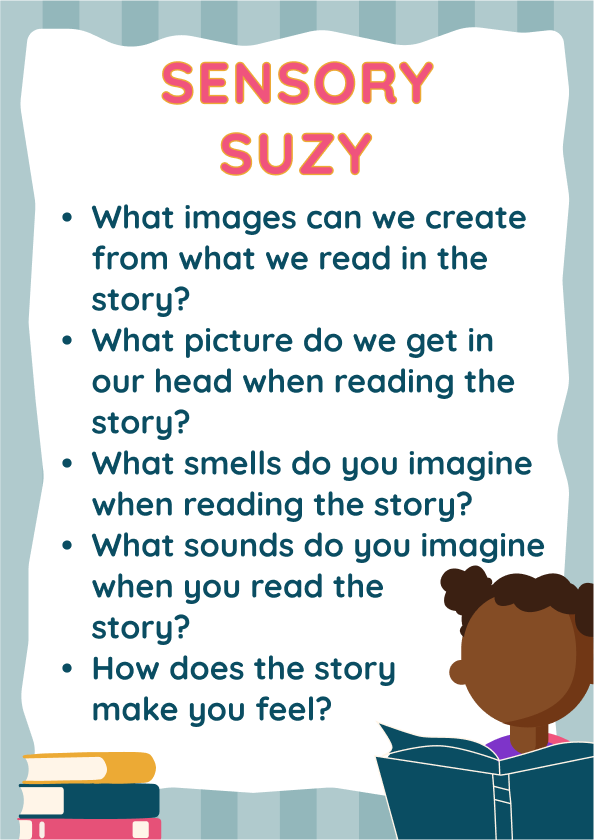
Lexplore also provides an additional fifth comprehension strategy that is important and is mainly used when reading fiction texts, namely "creating inner images".
Lexplore has customised the characters and given them their own names. You can also read about the fifth character that symbolises "Painting inner pictures".
Together with your pupils, you can come up with good characters/characteristics that pupils can relate to the different strategies. This can also increase pupil participation.
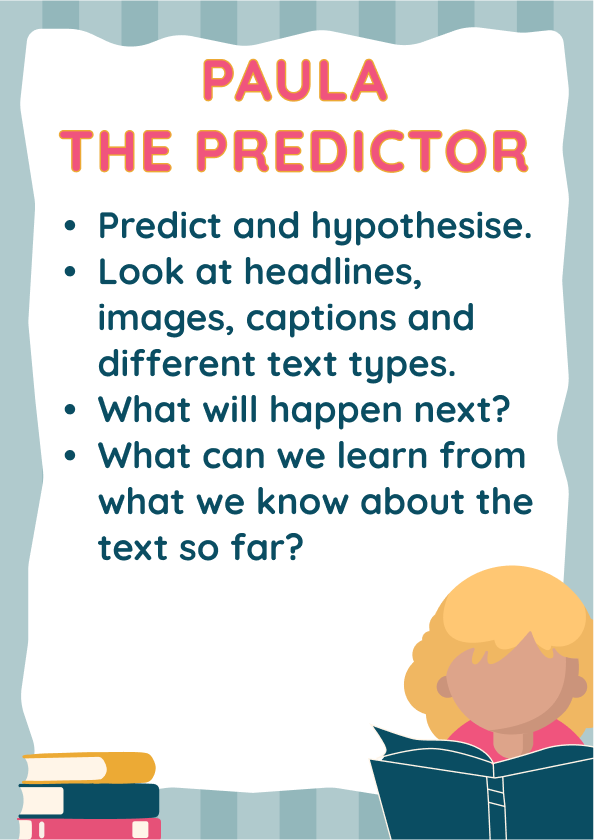
- Paula the Predictor predicts and hypothesises by looking at pictures and text.
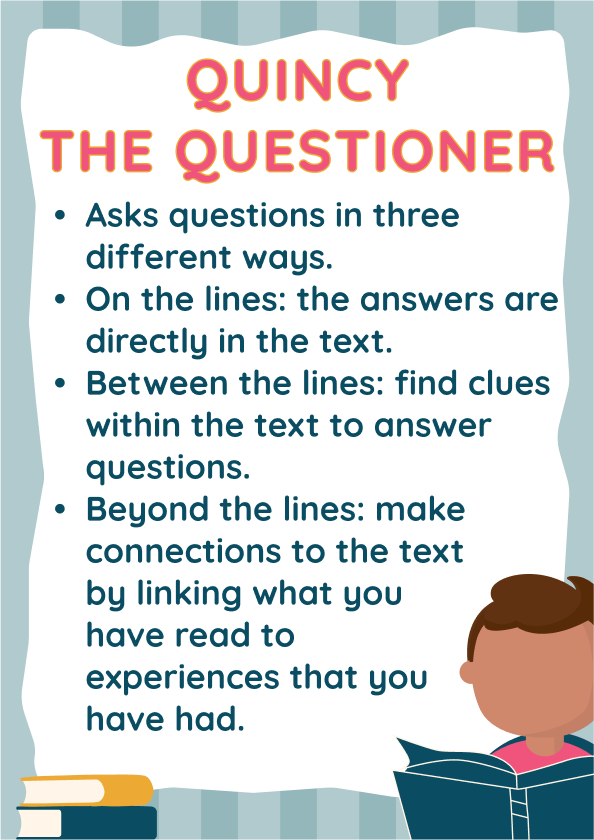
- Quincy the Questioner asks questions about the text.
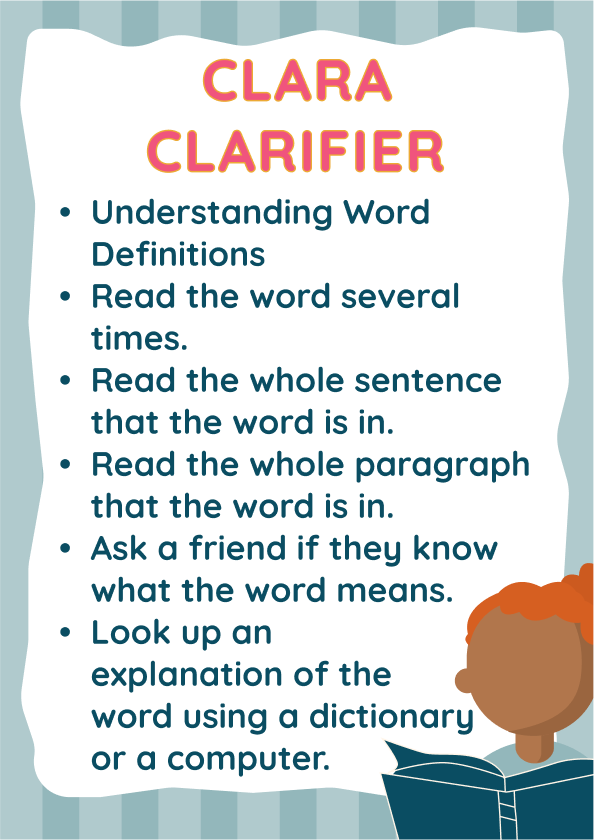
- Clara Clarifier explains new words and concepts.
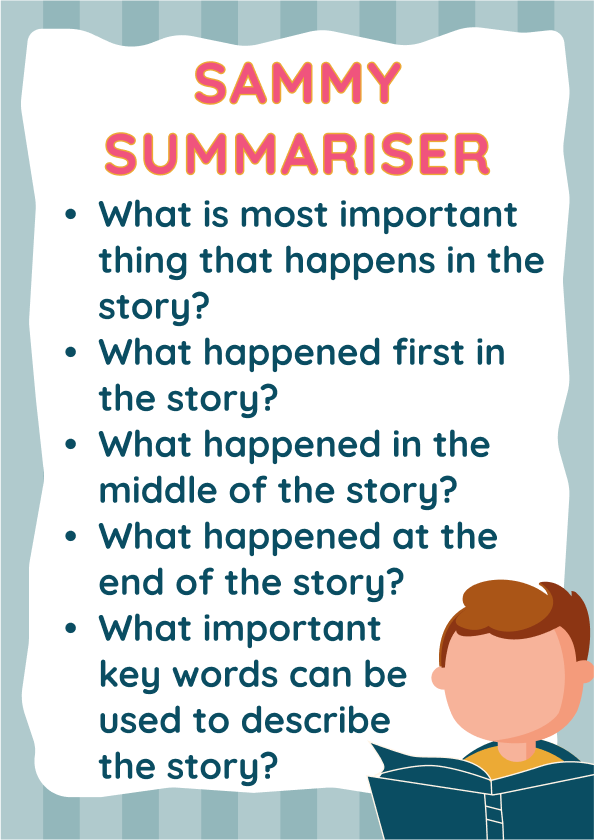
- Sammy Summariser summarises the content of the text.
- Sensory Suzy creates mental images of what you read.
You can also use symbols, pictures drama or hand gestures to personalise the different strategies if you wish.
For the youngest pupils, the first step is to introduce the characters. As pupils become more confident with the strategies, you can move on to using the five concepts which are:
- Predicting and hypothesising
- Asking questions
- Clarifying ambiguities
- Summarising
- Visualising
See yourself as the pupils' guide on the journey to becoming independent readers!