Antonyms
Purpose
In these lessons, students work with antonyms to develop vocabulary.
Procedure
Gather the class.
Lesson 1
Gather the students.
- Today we will work with words.
- We are going to work with words that mean the opposite to each other.
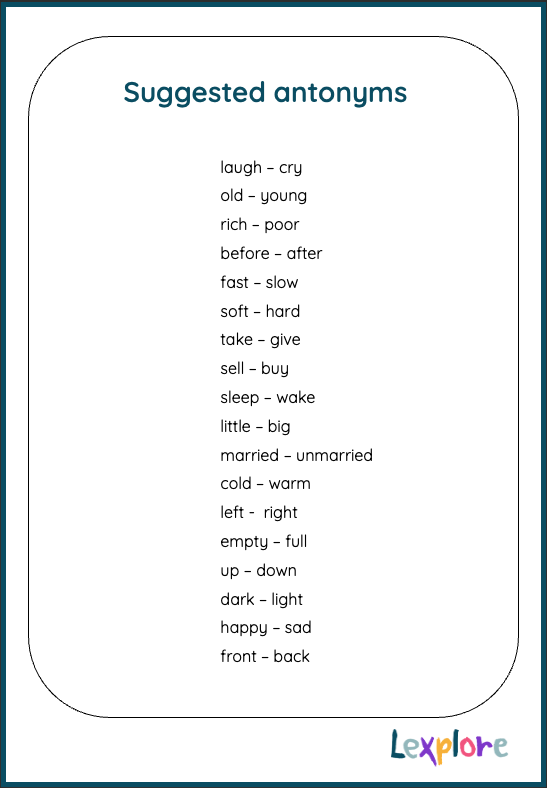
- Words that mean the opposite of each other are called antonyms, such as young and old or big and small.
- I will now give each of you a word (use the list at the beginning of this lesson plan).
- Read your word or ask me for help reading your word.
- Keep the word secret from your classmates!
- Someone in the class has a word that means the opposite of your word. Try to find the classmate who has the antonym to your word. When you have found each other, sit back down.
- You may begin.
When everyone is finished, gather the class again. Now you will go through the antonyms together.
- Now you will share the pairs of antonyms with the class and write them up together.
- Now you going to create a memory of the opposing words you have written, for example, the word young on one card and the word old on another.
- Each pair makes their memory.
Having an envelope or something similar for them to put their memory in is a good idea.
- You will now play memory with your game!
Let the students play the game on a couple of occasions so that they establish how the words are connected.
Lesson 2
Gather the class. The students try to make sentences using the antonyms.
- Today, we will make sentences with the help of antonyms. The pairs of antonyms should be used in the same sentence. For example: The cat is young, and the dog is old.”
- You will write your sentences using antonyms.
Have the students read their sentences to a small group or the whole class.
You can let the them write their own stories using as many antonyms as possible.